
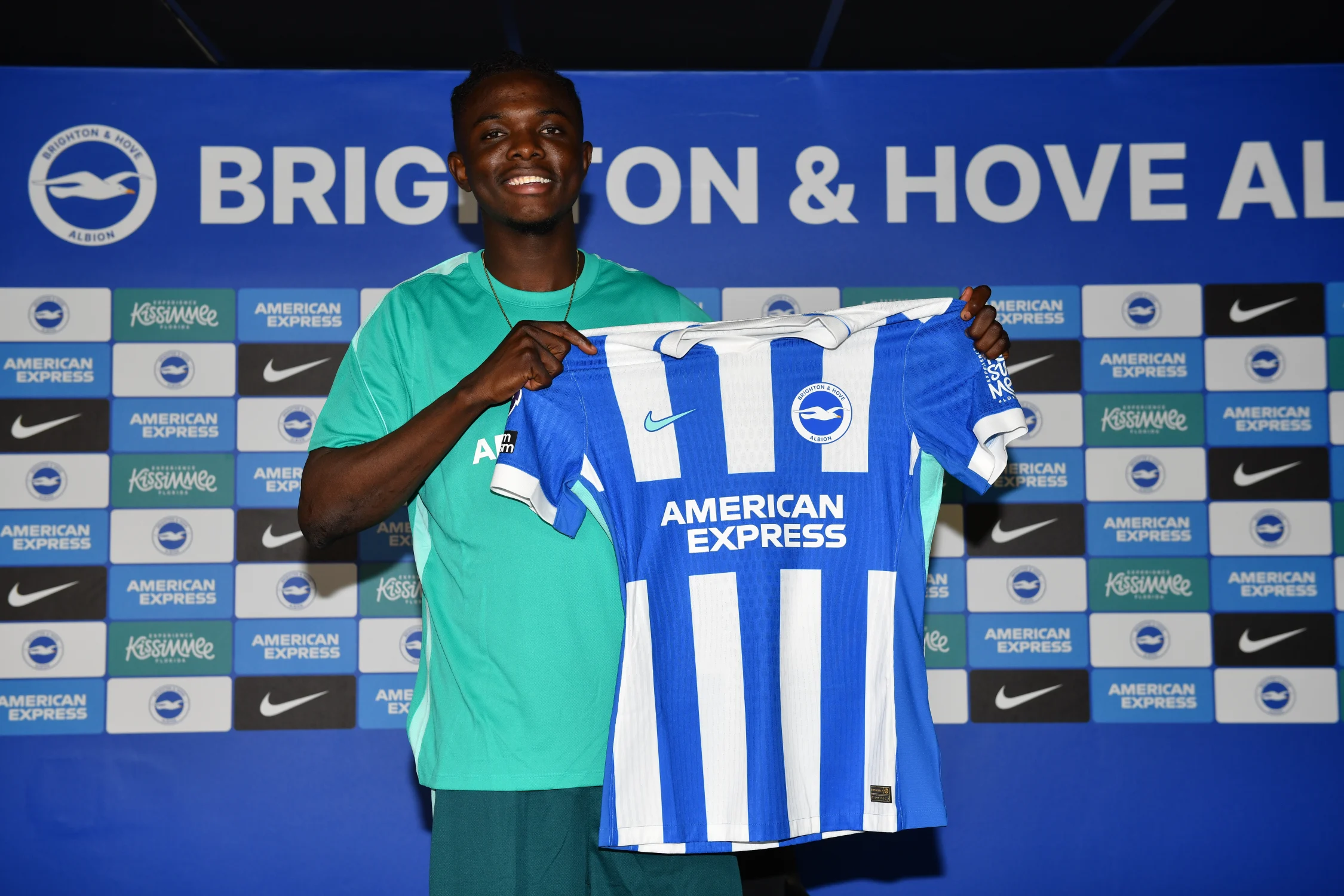
A year ago, Zadok Yohanna was still an unfamiliar name outside the football circles that had watched him grow in northern Nigeria. Today, he is a Brighton & Hove Albion player.
That is the headline. The more revealing story lies in the speed—and improbability—of the journey beneath it.
Yohanna has travelled from Bauchi to an academy home in Kaduna, survived rejection from Nigeria’s youth teams, adapted to Swedish football and earned a five-year contract with one of the Premier League’s most admired talent developers. Brighton confirmed the deal with AIK Stockholm on 6 June 2026. The club did not disclose the fee, although multiple reports have valued the transfer at about £21.5 million.
For an African teenager with barely a full season of senior European football behind him, that kind of investment is not a reward for what he has already become. It is a bet on what Brighton believe he can be.
The boy from Bauchi
Yohanna was born in Bauchi State on 29 June 2007. His route into organised football did not begin in a famous European-linked academy or a polished Lagos development programme. According to reporting by Premium Times, a friend of Ikon Allah Football Academy founder Ali Mohammed spotted the young player in Bauchi and recommended him to the Kaduna-based academy.
With his family’s approval, Yohanna moved to Kaduna at about 12 years old. It was a serious decision at an age when most children are still navigating secondary school. Mohammed’s household became part academy, part home: food, clothing, medical care and daily guidance were folded into the work of developing the player.
Ikon Allah is not a fashionable name to many global football fans, but it has produced professionals. Its graduates include Nigeria international Chidera Ejuke, as well as youth internationals Isaac Ayuma and Joshua John. Yohanna became the academy’s most dramatic advertisement for what can happen when local identification, patient care and international scouting meet.
Rejection came before recognition
The clean version of a breakout story usually removes the failed auditions. Yohanna’s did not.
He reportedly missed out on Nigeria’s under-17 setup in 2023 and the under-20 side in 2025. A scouting opportunity in 2024 also failed to produce an immediate move after one evaluator decided he was not ready for the next level.
Those decisions now look striking, but they should not be rewritten as proof that every scout was foolish. Teenagers develop unevenly. A player can be physically, tactically or emotionally unready in one window and look transformed months later. Yohanna’s story is useful precisely because rejection was not the final verdict.
The decisive assessment came when AIK scout Herish Sadi watched him in Nigeria in 2025. Sadi saw a player comfortable as a number 10 or winger: smooth on the ball, explosive over short distances and difficult to read in one-against-one situations. AIK moved quickly.
Stockholm changed everything
Yohanna joined AIK in 2025, initially entering the under-19 structure. He was promoted rapidly and made his senior debut in August. His first six appearances passed without a goal, an ordinary reminder that talent rarely arrives in Europe fully formed.
Then the game began to slow down for him.
Under a reshaped coaching structure, Yohanna grew into a decisive attacker. Brighton’s official account credits him with five goals and four assists across 18 league and cup appearances in the 2026 season before the transfer was announced. AIK technical director Peter Wennberg praised not only the teenager’s close control and acceleration but also his reaction after losing possession—an increasingly important detail for any forward entering a high-intensity Premier League side.
Zadok Yohanna at a glance
- Born: 29 June 2007, Bauchi State, Nigeria
- Position: Winger or attacking midfielder
- Development path: Ikon Allah Football Academy → AIK Stockholm → Brighton & Hove Albion
- AIK 2026 return before the deal: Five goals and four assists in 18 league and cup appearances
- Brighton contract: Five years, running to June 2031
What Brighton have actually bought
Yohanna is not a conventional touchline winger who simply runs toward the corner flag and crosses. He can receive inside, operate behind a striker and attack from the right onto his stronger areas. His appeal comes from changing pace sharply, carrying the ball under pressure and forcing defenders to make early decisions.
Brighton head coach Fabian Hürzeler highlighted the same traits when the deal was announced: pace, dynamism, creativity and the willingness to take players on. Those qualities give Yohanna a chance to influence games in the final third even before every part of his game is polished.
There is also a tactical reason Brighton makes sense. The club’s recent identity has been built around brave possession, positional flexibility and creating pathways for young players. Yohanna himself said Brighton’s record of using and developing youth shaped his decision.
Yet potential should not be confused with readiness. The Premier League will test his first touch at greater speed, his choices in crowded areas, his defensive discipline and his ability to produce when opponents have studied him. Sweden offered space for growth. England will offer far less space—and much louder judgment.
Why Brighton may be the right club
Brighton’s recruitment model is no longer a secret. The club identifies players before their reputations peak, places them in a demanding football structure and allows value to grow with performance. Moisés Caicedo, Alexis Mac Allister and João Pedro are different players with different histories, but each illustrates Brighton’s willingness to trust youth before the rest of the market is fully convinced.
That reputation helps Yohanna in two ways. First, Brighton did not sign him merely for a social-media unveiling; the club has an economic and sporting incentive to develop him. Second, the organisation understands that a young arrival may need time.
Wennberg’s most important warning was patience. Yohanna moved from academy football in Nigeria to Sweden, and now to the most scrutinised league in the world, in a remarkably compressed period. A quiet first six months would not mean the transfer has failed. It might mean the development plan is working at a human pace.
Three futures now sit in front of him
The best-case path is that Yohanna adapts quickly, earns controlled first-team minutes and becomes a dangerous rotation option across the front line. His directness could be particularly valuable late in matches when defenders are tired. If his decision-making catches up with his physical gifts, he has the ceiling to become a regular Premier League attacker.
The more realistic path may include patient integration: cup appearances, substitute minutes, development football or even a carefully chosen loan. That would not diminish the transfer. At 19, consistent competitive minutes matter more than the prestige of sitting on a Premier League bench.
The danger is that the size of the reported fee creates expectations his experience cannot yet carry. Young African players are often described as either “wonderkids” or disappointments, with little room for the ordinary years of technical and emotional development between those labels. Brighton must protect the process. Yohanna must keep improving when the novelty fades.
And what about Nigeria?
Yohanna has already moved into the Super Eagles conversation. He was selected for Nigeria’s Unity Cup squad in London in 2026, although his senior debut was delayed after AIK did not release him while he was recovering and remaining important to the club.
Nigeria has no shortage of attacking talent, so reputation alone will not secure him a national-team place. His versatility helps, but his route into the side will depend on club minutes, end product and tactical reliability. If he establishes himself at Brighton, however, the debate will quickly change from whether he belongs in the squad to where he fits in the team.
A transfer bigger than one player
Yohanna’s rise also says something about African football’s talent chain. The glamorous part happened in Brighton. The essential work began in Bauchi and Kaduna, where someone noticed a child, a family took a risk, and a local academy invested years before a European club attached a large number to his name.
That is why his story should not be reduced to a reported transfer fee. The money makes the headline. The network of belief behind him makes the career possible.
Zadok Yohanna is not yet Nigeria’s next Premier League star. He is something more interesting: a player with the tools, the environment and now the opportunity to become one.
His next chapter will be harder than the last. It may also be the making of him.